Keystone Pickleball Tournament – Dill Dinkers, Newport, DE (1/31–2/1/2026)
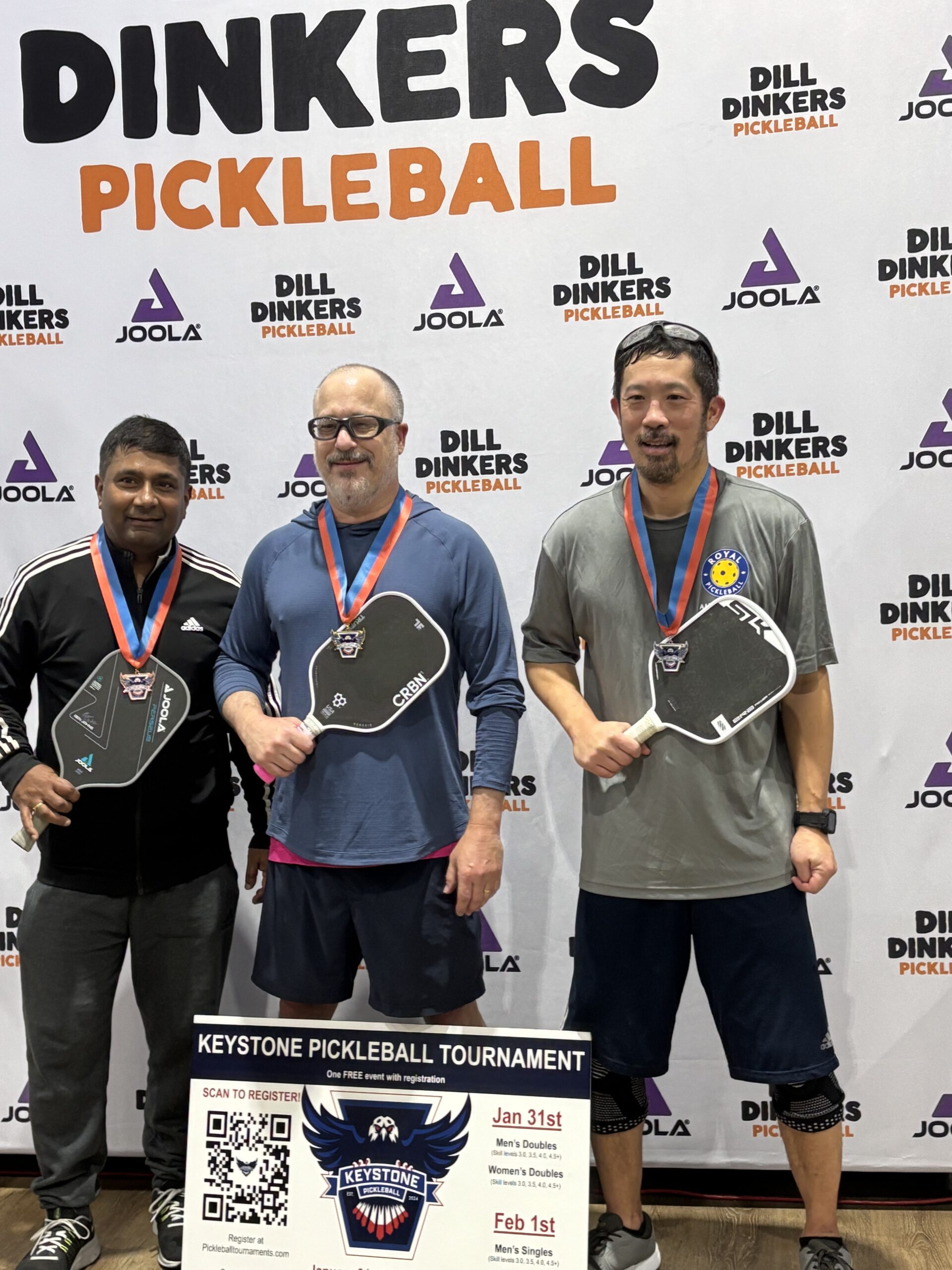
I played my first official pickleball tournament this past weekend at the Keystone Pickleball Tournament hosted at Dill Dinkers in Newport, Delaware. I competed in the 50+ 3.5 division in both singles and doubles, and walked away with a lot of clarity about my game—what’s working, what’s not, and where I need to focus if I want to keep leveling up.
Here are my biggest takeaways.
1. My Singles Game Is Well Ahead of My Doubles Game
This one was clear as day, and the numbers back it up.
- Singles DUPR: 3.764
- Doubles DUPR: 3.193
I’ve always suspected my singles would be stronger, but seeing that gap after my first tournament really confirmed it. My athletic background, speed, and comfort covering the entire court play much better in singles than in doubles, where patience, touch, and shot selection matter more than raw movement.
That said, the gap also tells me exactly where the work needs to happen.
2. Conditioning Is the Biggest Limiting Factor in Singles
Skill-wise, I felt competitive. Conditioning-wise? Not even close.
As a former Division 1 sprinter, short bursts of speed are still an asset—but pickleball singles is a different animal. Long rallies, repeated lateral movements, and staying sharp deep into matches exposed a real weakness.
I lost to the eventual gold medalist, who finished the tournament rated 4.2+, and while I didn’t win, I could compete. The difference wasn’t shot-making—it was endurance.
That’s actually encouraging. Conditioning is fixable.
3. My Backhand Is a Weapon (and Carried Me to Silver)
One of the biggest surprises for me was how well my backhand held up in singles—better than my forehand.
Why?
- It’s more compact
- Fewer moving parts
- More reliable under pressure
My backhand consistency and ability to pass or counter off that side played a huge role in me taking silver in singles. Even more interesting: most of my opponents had very weak backhands, which opened up the court and gave me predictable patterns to attack.
At this level, a solid backhand is a massive advantage.
4. Doubles Confirmed What I Already Knew (But Needed Reinforced)
Doubles was… humbling—but not surprising.
The issues were exactly what I expected:
- I drive too much
- I don’t drop enough
- I speed up at the wrong times
- I get impatient in dink rallies
The key realization wasn’t that I need to dink more—it’s that I can still dink aggressively, with intent, instead of forcing speed-ups that aren’t there. At higher levels, bad speed-ups don’t just lose points—they swing momentum fast.
Doubles isn’t about proving you can hit hard. It’s about choosing the right ball to attack.
5. This Tournament Gave Me Direction
That’s the biggest win from the weekend.
I now know:
- Singles potential is there—but conditioning has to catch up
- My backhand is a strength I should lean into
- Doubles improvement will come from patience, drops, and smarter speed-ups
For a first tournament, that’s exactly what you want: clarity, not confusion.
If you’re on the fence about playing your first tournament, do it. Ratings aside, the feedback you get from real competition is invaluable—and it will accelerate your improvement far faster than rec play alone.
On to the next one 👊🏓